The AI Readiness Gap: What 100 Digital Agency Websites Reveal About AI Visibility
Digital agencies are used to helping clients improve search visibility, content performance, conversion and online authority. But AI search is changing the rules.
As more people use tools like ChatGPT, Perplexity, Gemini and Google AI Overviews to discover suppliers, compare expertise and ask for recommendations, the question is no longer just: “Does this agency rank in search?”
It is also: “Can AI systems clearly understand what this agency does, who it helps, what it is credible in, and when it should be recommended?”
As part of a wider 1,000-site AI Visibility analysis, I reviewed a sample of 100 digital agency websites to explore how clearly agencies are presenting themselves to AI systems.
The findings are mixed — and revealing. Some agencies show strong AI visibility signals. Others look polished on the surface but are harder for AI systems to interpret confidently. That creates what I would describe as an AI readiness gap.
Headline findings
Across the 100 digital agency websites reviewed:
- 13% showed Authoritative AI Visibility
- 40% showed Strong Visibility
- 17% showed Emerging Visibility
- 8% showed Weak Visibility
- 21% were effectively Invisible in the audit
The average AI Visibility Score was 53.6, while the median was 67.3. That difference between average and median is important - it suggests a split market.
A substantial group of agencies are performing reasonably well, but a meaningful minority are being pulled down by weaker structure, access issues, unclear authority signals or limited crawl behaviour. In other words, the agency sector is not uniformly weak. But it is inconsistent.
The key question: are agencies AI-ready themselves?
Many agencies are already talking to clients about AI, automation, content strategy, search disruption and digital transformation. That makes this sector particularly interesting.
If agencies are going to advise clients on visibility in an AI-shaped search environment, their own websites need to send clear signals too.
Those signals include:
- What the agency specialises in
- Who it works with
- What services it provides
- What evidence supports its expertise
- What results it can credibly claim
- Who the experts are behind the content
- How its insight content connects to its services
The issue is not whether agencies understand marketing. The issue is whether their websites make their expertise clear enough for AI systems to interpret, trust and recommend.
The most common profile: Credible, but Unclear
The most common profile in the agency sample was Credible but Unclear, affecting 33% of sites. That is a significant finding.
It suggests that many agency websites are not lacking credibility. They often have strong branding, case studies, service pages, clients, awards, content and sector experience.
But those signals are not always connected clearly enough.
For a human visitor, a visually impressive agency site may feel persuasive. For an AI system, the important question is different: Can the site be confidently understood, categorised and matched to a specific user need?
A website might say:
- “We drive growth”
- “We create digital experiences”
- “We help ambitious brands scale”
- “We combine creativity, performance and technology”
Those statements may be attractive, but they do not always explain enough. AI systems need clearer signals around:
- Specific services
- Specialist sectors
- Proven expertise
- Named methodologies
- Measurable outcomes
- Relevant case studies
- Expert authorship
Without those signals, the agency may look credible but remain difficult to recommend confidently.
A second pattern: Obstructed Discovery
The second most common profile was Obstructed Discovery, affecting 27% of sites.
This does not necessarily mean those agencies are poor performers commercially or lack expertise.
It means the audit found barriers that made the site harder to assess or interpret.
Across the sample:
- 32% had host-handling or access concerns
- 25% showed low crawl confidence
- 21% showed limited crawl behaviour
For the purposes of this snapshot, the aim is not to dwell on individual sites that did not assess cleanly. The broader point is more useful: AI visibility depends on access as well as content.
If a website creates crawl, host, redirect, sitemap or structural confusion, it can reduce how easily AI systems discover and interpret the organisation’s expertise. This is especially relevant for agencies, because technical polish and front-end design do not always guarantee machine-readable clarity.
The strongest agencies were not just “well designed”
A good agency website does not need to be boring, formulaic or over-optimised.
But the stronger sites in the sample tended to combine brand polish with clearer structural signals.
They were more likely to make obvious:
- What the agency does
- Which services matter most
- What sectors it understands
- Where its authority comes from
- How case studies connect to service capability
- Whether content is authored by visible experts
- How insights support commercial positioning
This matters because AI systems do not simply “like” good design. They need to extract meaning. The strongest agency sites are not just attractive. They are interpretable.
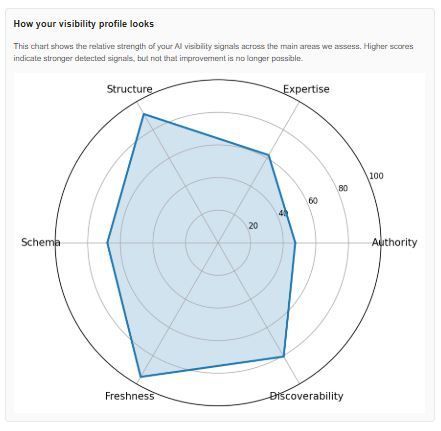
The weakest signals: Structure, Authority and Schema
Across the 100 digital agency websites, the weakest recurring signals were:
- Structure
- Authority
- Schema
In practical terms, this means many sites could improve how clearly they organise, label and connect their information.
The weakest signal was Structure for 50% of sites. That is one of the most important findings in the report.
It suggests that many agencies may have useful information on their websites, but the content is not always arranged in a way that helps AI systems build a coherent picture of the business.
Common structural issues include:
- Broad service pages that lack depth
- Unclear relationship between services and case studies
- Insight content that is disconnected from commercial positioning
- Weak internal linking between expertise areas
- Limited explanation of methodology
- Unclear author or expert attribution
- Vague sector positioning
- Inconsistent language around services and outcomes
This does not mean every agency needs to rebuild its site. But it does suggest that “looking good” and “being AI-readable” are not the same thing.
The attribution gap
One particularly interesting issue was attribution. In the wider review of the agency sample, more than half of the sites showed signs of weak visible author or expert attribution. For agencies, this matters.
Many agencies publish blogs, trend reports, campaign insights and strategic opinions. But if those pieces are not clearly connected to named experts, teams or areas of specialism, the authority signal can be weaker.
AI systems are increasingly trying to understand not just what is said, but who is saying it and why they should be trusted. For an agency, that means thought leadership should not feel anonymous.
Useful improvements include:
- Named authors on insight content
- Expert bios linked from articles
- Clearer team expertise pages
- Visible strategist, SEO, content, UX or performance specialists
- Case studies connected to relevant service leads
- Stronger links between content topics and service capability
This is not just a technical SEO issue. It is an authority issue.
The Agency Paradox
The most interesting finding from this sector is what I would call The Agency Paradox.
Many agencies are highly skilled at making clients look credible online.
But their own websites sometimes make their expertise harder to interpret than it needs to be.
This can happen because agency websites often prioritise:
- Creativity
- Brand language
- Visual impact
- Broad positioning
- Campaign showcase content
- High-level service messaging
Those things can be valuable. But AI systems also need clarity, consistency and evidence.
An agency may be impressive, but if its specialisms, expertise and proof are scattered or implied, AI systems may struggle to understand when to recommend it.
What agencies can do about it
Improving AI visibility does not mean abandoning good design or writing robotic content. It means making expertise easier to interpret.
Here are five practical areas agencies should review.
1. Make specialisms explicit
If you are strong in SEO, paid media, brand strategy, content, UX, performance marketing, ecommerce, B2B lead generation or AI search, say so clearly.
Avoid relying only on broad phrases like “digital growth” or “full-service marketing”.
2. Connect services to evidence
Service pages should not sit separately from proof.
Each core service should connect to relevant:
- case studies
- results
- testimonials
- insight articles
- sector examples
- team expertise
This helps AI systems understand not just what you offer, but what supports your authority.
3. Strengthen expert attribution
If your agency publishes insight content, make it clear who is behind it.
Named authors, team bios and specialist profiles can strengthen trust signals.
4. Build clearer content pathways
Insight content should connect back to commercial themes.
If you write about AI search, SEO, brand strategy, content performance or conversion, make sure those articles support a clear area of expertise on the site.
5. Review technical access and crawl clarity
Redirects, host handling, sitemap quality, crawl paths and internal linking all affect how easily a site can be assessed and interpreted.
A site can look modern to users while still creating confusion for crawlers and AI systems.
The bigger takeaway
The digital agency sector is ahead of many industries in some respects. Many agencies have active websites, fresh content, case studies and strong digital brands. But the sector also shows a clear AI readiness gap.
The agencies most likely to benefit from AI search will not simply be those with the best-looking websites. They will be the ones whose expertise, specialisms, people, proof and content are structured clearly enough for AI systems to understand, trust and recommend.
That is the challenge — and the opportunity. As AI search becomes more influential, agencies will need to think beyond traditional rankings.
The future of visibility will depend not only on whether a site can be found, but whether it can be confidently interpreted.
About this snapshot
This article is based on early findings from a wider 1,000-site AI Visibility analysis by Digable Marketing.
The purpose of this snapshot is not to rank or criticise individual agencies, but to identify sector-level patterns and practical opportunities for improvement.
Individual scores are not published here. The focus is on what the sector as a whole reveals about AI visibility, authority and search readiness.
If you would like to run our AI Visibility Audit on your own agency website you can do so here: Ai Visibility Assessment